


Special cat food only does its job when the right cat gets to eat it. For families buying a veterinarian-recommended diet, another cat or dog finishing the bowl is more than a mealtime nuisance: it makes intake harder to track and can increase the cost of replacing meals.
How Many Cats Need Special Diets?
There is no reliable worldwide count we can cite for cats currently eating therapeutic diets, or the annual increase in that number. Pet population, disease prevalence, and prescription-food sales measure different things and should not be treated as interchangeable.
The available evidence still shows why this matters. Cornell University's Feline Health Center reports that chronic kidney disease can affect up to 40% of cats over 10 years old. This is a disease-prevalence estimate for older cats, not a count of cats prescribed special food. Source: Cornell Feline Health Center.
Meanwhile, APPA's 2026 State of the Industry summary reports that 53 million U.S. households owned a cat in 2025 and identifies cat ownership as a growth driver. This describes the scale of cat ownership, not global growth in feline illness or therapeutic-diet use. Source: APPA, 2026 State of the Industry.
For an individual household, the practical question is simpler: how do you keep the food you carefully selected for one cat from becoming everyone else's snack?
When Another Cat or Dog Eats the Special Food
A slower eater may take a few bites, leave, and return later. A faster cat may move straight to the unfinished bowl. In a mixed-pet home, a dog may also discover an easy extra meal.
This creates three practical problems:
- Uncertain intake: an empty bowl does not tell you which pet ate the food.
- Replacement costs: repeatedly replacing stolen portions can increase spending.
- Diet mix-ups: the cat on a special diet may also visit another pet's bowl.
Protecting only the special-food bowl solves only one direction of access. If your cat must avoid other foods, those foods also need to be kept out of reach. Follow your veterinarian's feeding instructions and monitor appetite and intake.
Common Ways to Keep Meals Separate
| Approach | What works well | What to consider |
|---|---|---|
| Feed in separate rooms | Low equipment cost; clear separation with doors closed | Requires access to suitable rooms and a routine; less convenient for a cat that grazes |
| Supervise every meal | Lets you see who eats and notice appetite changes | Takes time; protection stops when supervision stops |
| Move the bowl higher or use a gate | May keep some dogs away | Other cats may still reach it; elevated access may not suit every cat |
| Use a timed feeder | Automates scheduled meal delivery | An open bowl usually does not identify the pet eating from it |
| Use a microchip-access feeder | Helps reserve food for a paired pet, including between scheduled meals | Requires compatibility checks, training, cleaning, and observation of actual pet behavior |
No single setup fits every home. Physical separation may remain the right option for a pet that cannot safely or comfortably use a selective feeder.
SureFeed: Selective Access Instead of an Open Bowl
SureFeed's Microchip Pet Feeder is an established option for multi-pet households. It recognizes registered microchips or compatible RFID tags and opens the lid for the authorized pet. Its standard model supports wet and dry food and includes a training mode.
Sure Petcare also offers stainless steel bowls and split-bowl options. The standard feeder uses four C-cell batteries, and its accessory range includes a rear cover. These are useful choices to compare rather than features to assume the brand lacks. SureFeed standard feeder specifications; official accessories.
The practical issue to assess with any selective feeder is access while the intended pet is eating: can another pet approach from the side, reach around the back, or crowd the opening? Test this in your own home rather than relying on an absolute anti-theft claim.
How ePawDen Approaches Those Everyday Challenges
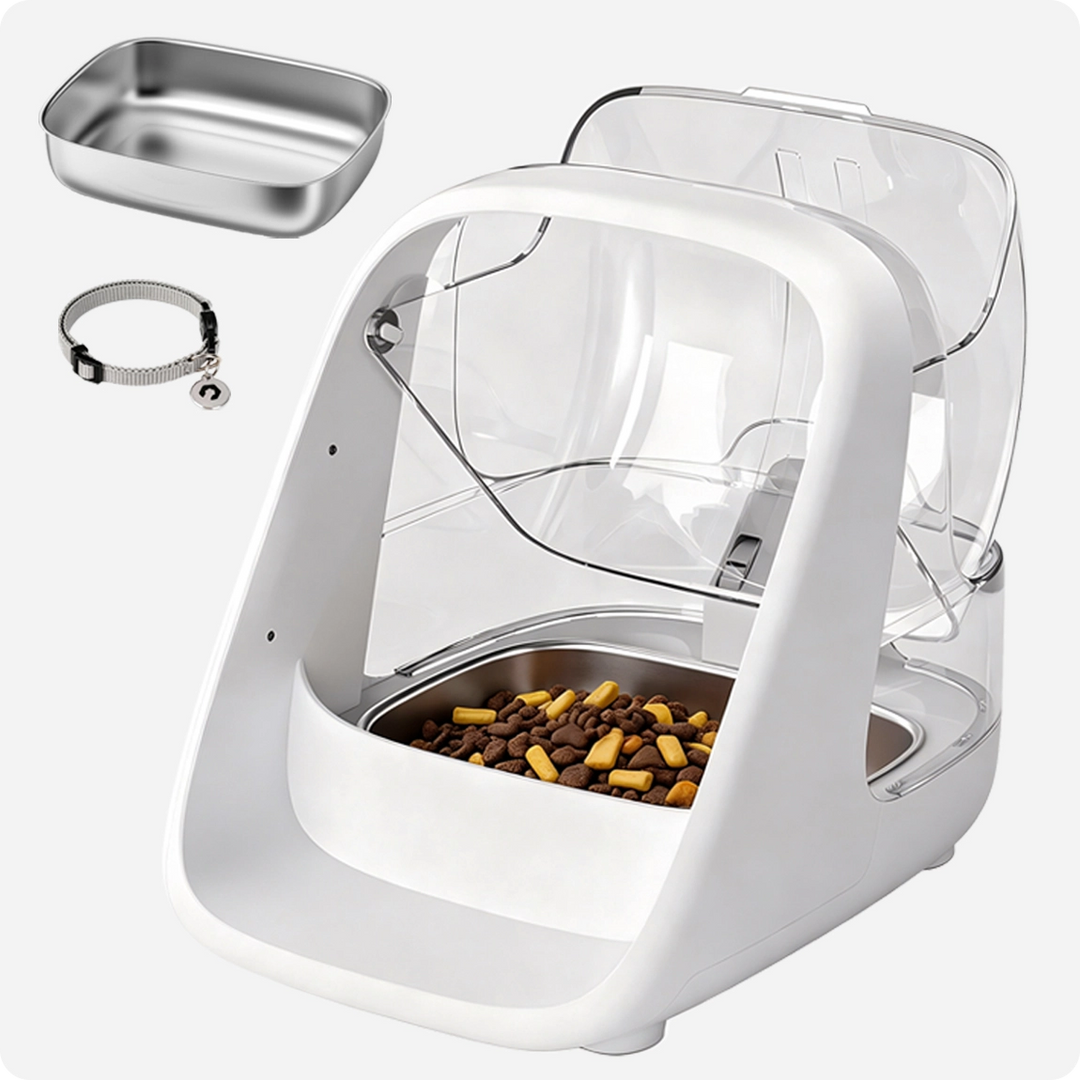
At ePawDen, our selective-access design focuses on meal protection and a manageable daily routine. Compared with the standard SureFeed configuration described above, the differences worth considering are:
- Built-in rear and side shielding: the feeder's enclosed structure helps limit access from behind and the sides. Separate ePawDen Side Guards are available to add protection around the front approach; they are an optional accessory.
- Built-in rechargeable battery: USB-C charging avoids the routine purchase of disposable C-cell batteries. The feeder still needs charging and battery monitoring.
- Stainless steel bowl included: the standard removable 304 stainless steel bowl is supplied with the feeder, rather than requiring a separate bowl upgrade.
- A divided stainless steel option: an optional two-compartment bowl lets you arrange two appropriate foods for the same authorized pet.
These are design and configuration differences, not evidence that one feeder prevents every attempted theft or produces better medical outcomes. Compare the exact model, accessories, compatibility, and your pets' behavior before choosing.

Can Protecting Food Save Money?
It can reduce replacement spending if food stealing is a regular problem, but savings depend on how much food is actually being lost and how well your setup prevents it.
Illustration, not a savings guarantee: if you currently replace US$0.75 of stolen food each day, that is US$22.50 over 30 days, or US$273.75 over 365 days. Preventing half that loss would avoid half that replacement cost, before equipment and operating costs.
Track one or two weeks of feeding first: food offered, food left, observed theft, and any replacement portions. Do not count all uneaten food as theft, and never reduce a prescribed ration simply to offset the cost of a feeder.
The goal is to spend more of your food budget on the intended cat's meals, not to promise lower veterinary bills.
Two Foods, One Cat: The Divided Stainless Steel Bowl
The ePawDen Divided Stainless Steel Bowls - 2 Pack lets you offer two suitable foods side by side. For example, your veterinarian may approve wet and dry versions of a diet, or a specific food-transition plan.
Each compartment holds approximately 150 ml up to the divider; the full bowl holds 400 ml to the rim. Fill below the divider when you want the foods to remain separate. These measurements refer to the divided accessory bowl, not the standard 500 ml bowl.
Both compartments open together. Any authorized pet can access both foods. The divider does not provide separate access for two cats, prevent cross-contact, or make an incompatible food safe for a cat on a restricted diet. For an elimination trial or another strict feeding plan, use only foods your veterinarian approves.

Lift the bowl out for washing, use mild detergent, rinse thoroughly, and dry before reuse. A covered feeder does not refrigerate food: follow the food manufacturer's serving and storage instructions.
A Practical Setup for Protecting a Special Diet
- Confirm the diet, portions, and feeding schedule with your veterinarian.
- Check microchip compatibility. ePawDen supports compatible 15-digit ISO FDX-B chips at 134.2 kHz, or its RFID collar tag.
- Pair only the pet or pets who should access that particular food.
- Place the feeder in a quiet, accessible spot and introduce it gradually using the supplied instructions.
- Observe approaches from the front, sides, and rear. Adjust positioning or accessories if another pet finds a way to share the meal.
- Protect the other pets' food too if your special-diet cat must not eat it.
- Continue checking intake, cleaning the bowl, refreshing food, and monitoring the battery.
Protect the Meal, Not Just the Bowl
Special-diet feeding is about keeping the right food available to the right pet. A well-matched microchip feeder can substantially reduce opportunities for food stealing and make separate feeding easier, but it is not a substitute for observation or veterinary guidance.
Start with the feeder, add a divided bowl only if it suits your cat's approved menu, and choose extra guards according to the behavior you actually see.
Explore the ePawDen Microchip Feeder
Shop divided stainless steel bowls · Explore optional Side Guards
Published by ePawDen. Product comparison checked September 2026 and refers to the standard SureFeed Microchip Pet Feeder, not every SureFeed model. Specifications and accessory availability can change. This article provides feeding-equipment information, not diagnosis or treatment advice.


Leave a comment